

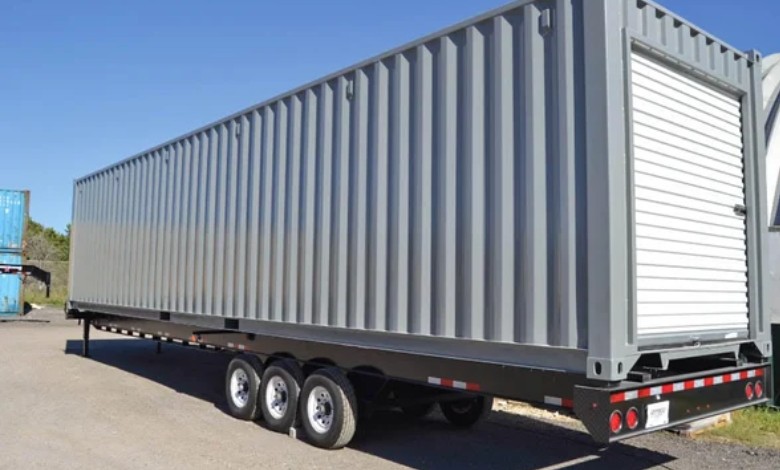
Shipping containers have become incredibly popular in the Aurora area and across Ontario, repurposed for everything from secure storage and temporary offices to trendy tiny homes and workshops. When the time comes to move these massive steel boxes—whether a standard 20-foot unit or a large 40-foot cube—many people search for a way to tow a sea container by Ourself to save on costs.
The image of hooking up a pickup truck or farm tractor to a five-figure-pound object and rolling it down the highway is a compelling, but ultimately dangerous and illegal fantasy.
At Pars Towing in Aurora, Ontario, we specialize in the safe, legal, and compliant transport of sea containers.1 This comprehensive guide is not a “how-to” for DIY transport, but a critical, educational resource explaining why attempting to tow a sea container by Ourself on Ontario’s public roads is virtually impossible, incredibly risky, and a fast track to massive fines, vehicle damage, and serious accidents. The sheer weight, specialized securing methods, and strict provincial road laws demand commercial, heavy-duty expertise.2
- Learn More >>>>Towing sea container

Part I: The Immense Physics and Weight Barrier
The number one reason why DIY towing of a sea container fails is simple physics: weight. Containers are exponentially heavier than anything a non-commercial vehicle is rated to handle.
Understanding the True Weight
| Container Type | Tare Weight (Empty) | Maximum Gross Weight (Loaded Limit) |
| 20-Foot Standard | $\approx 2,200 \text{ kg } (4,850 \text{ lbs})$ | $\approx 30,500 \text{ kg } (67,200 \text{ lbs})$ |
| 40-Foot Standard | $\approx 3,750 \text{ kg } (8,265 \text{ lbs})$ | $\approx 30,500 \text{ kg } (67,200 \text{ lbs})$ |
Even an empty 20-foot container weighs nearly 5,000 pounds.3 A typical heavy-duty pickup truck might have a maximum towing capacity of 10,000 to 15,000 pounds. While this barely covers the empty container, it fails to account for:
- The Weight of the Trailer/Chassis: A commercial-grade container chassis or tilt-and-load deck, which is required for transport, adds another 5,000 to 7,000 pounds.
- The Hitch Type and Rating: A standard bumper hitch or even a typical consumer gooseneck hitch is simply not rated for the dynamic forces and high tongue weights associated with these loads.
The Reality Check: A loaded 20-foot container, which can easily reach the 67,200-pound maximum, requires an industrial-grade tandem or tri-axle transport vehicle combined with a specialized tractor unit—the type of equipment you will only find at a professional heavy-haul operation like Pars Towing.
- Learn More >>>>Towing Capacity For Each Truck
Part II: The Legal Minefield of Ontario MTO Regulations
Attempting to tow a sea container by Ourself on public roads in the Aurora area is not just a safety risk; it is a clear violation of Ontario’s stringent Ministry of Transportation (MTO) and the Commercial Vehicle Operator’s Registration (CVOR) laws, leading to crippling fines and vehicle seizure.
Commercial Vehicle Operator’s Registration (CVOR)
In Ontario, any vehicle combination (truck, trailer, and load) that exceeds a Registered Gross Weight (RGW) of 4,500 kg (9,920 lbs)—a weight easily exceeded by an empty 20-foot container on a trailer—is generally considered a commercial motor vehicle.4
This means the driver and vehicle must comply with complex regulations that a private vehicle owner cannot meet:
- Commercial Driver’s License (CDL): The driver must possess the appropriate class of commercial license (often a Class A or D).
- Hours of Service: Commercial drivers are strictly limited in the hours they can drive, requiring detailed logbooks.5
- Daily and Trip Inspections: The towing unit and trailer must undergo mandatory daily trip inspections documented by a licensed mechanic or a qualified driver.
The Takeaway: If you attempt to tow a sea container by Ourself on Highway 404 or any regional road, you will be operating an illegal commercial vehicle, instantly making you non-compliant, uninsured, and subject to immediate roadside penalties.
Oversize and Overweight Permits
A fully loaded container, or even an empty one on a specialized trailer, often exceeds the standard width, height, or weight limits defined by the MTO. Transporting an overweight or oversized load in Ontario requires a Special Vehicle Configuration Permit.
- The Permitting Process: Obtaining these permits is a complex, multi-day process involving route planning, insurance declarations, and MTO approvals.6 This is handled by Pars Towing as part of our specialized service.
- Axle Weight Limits: Ontario law strictly limits the weight placed on individual axles to protect infrastructure. The weight of a sea container must be precisely centered on a chassis with enough axles to distribute the load evenly. A typical personal trailer will place an illegal, crushing load on its few axles.
- Learn More >>>>Towing sea containers Ajax
Part III: The Impossibility of Proper Load Securement
The methods used to secure a couch or a boat trailer are fundamentally different from those required for a sea container. This critical safety step is where a DIY attempt becomes extremely hazardous.
The Role of Corner Castings and Twist Locks
Sea containers are designed to be secured using their corner castings, which are specialized holes located at all eight corners.7
- Professional Method (Twist Locks): Commercial container chassis trailers are equipped with twist locks that mate perfectly with the corner castings.8 When locked, these devices create a rigid, integrated connection between the container and the chassis, preventing any lateral or vertical movement during emergency braking or cornering.
- The DIY Failure: If you attempt to secure a container on a flatbed or standard trailer using chains, straps, or ropes, you risk a catastrophic failure. A 40,000-pound object shifting violently due to a sudden stop will rip through inadequate securement, potentially crushing the tow vehicle, causing a jackknife, or rolling into oncoming traffic. There is no safe, non-specialized way to secure a container to a standard consumer trailer.9
Braking and Control
The ability to tow a load is only half the battle; the ability to stop it is far more important.
- Mass and Momentum: The kinetic energy of a fully loaded container travelling at highway speed is enormous. A standard pickup truck’s braking system is engineered for its own weight plus a relatively light load. It simply lacks the capacity to stop an extra 50,000+ pounds of rolling mass.
- Commercial Braking Systems: Specialized heavy-haul trailers used by Pars Towing have their own powerful, multi-axle braking systems, often air-actuated, that are synchronized with the tractor unit. This independent stopping power is mandatory for safely hauling heavy loads in Aurora’s traffic conditions.

Part IV: The Local Transport Challenge (Short Distances)
What about moving the container only a very short distance, perhaps just across your property in the Aurora area? Even here, trying to tow a sea container by Ourself requires specialized equipment most homeowners do not possess.
On-Site DIY (Extremely Short Moves)
For moving an empty container on private, firm ground over a few feet, people have historically used primitive, high-risk methods:
- Pipes or Rollers: Using round pipe sections as makeshift rollers to shuffle the container short distances.
- Heavy Forklifts: Using industrial forklifts (rated 10$15,000 \text{ lbs}$ or higher) with wide tines.11 A standard warehouse forklift will buckle or tip.
- Hand Winches: Using industrial-grade hand winches and a series of anchor points to slowly drag the container.
These methods are extremely slow, highly dangerous, limited to empty containers, and impossible on public roadways. They carry high risks of:
- Tipping: Uneven terrain or a slight shift in weight distribution can cause the container to tip and fall.
- Ground Damage: The concentrated weight can severely damage driveways, lawns, and septic fields.
- Structural Damage: Improper lifting with narrow tines or chains can bend the container’s structural rails, devaluing it significantly.
- Learn More >>>>Towing sea containers Whitby
Conclusion: Don’t Attempt to Tow a Sea Container by Ourself
The urge to tow a sea container by Ourself is understandable, but the reality is that the weight, the specialized equipment required, and the strict legal framework in Ontario make DIY transport of a sea container on public roads an impossibility. It is a recipe for major fines, vehicle damage, and catastrophic accidents.
A standard 20-foot container is a 5,000-pound empty shell that turns into a 67,000-pound legal liability. Don’t risk your license, your property, or the safety of others.
For safe, legal, and professional heavy-haul container transport in Aurora and across Ontario, the only smart choice is Pars Towing. Our expertise and specialized equipment are your guarantee that your container move will be handled correctly from start to finish.
